
Somewhere around the third coffee of a cold Sydney workday, winter starts leaving its signature on your smile. Coffee, tea and red wine season runs hard from June through August, and by the time the weather turns, plenty of CBD professionals notice their teeth looking a shade or two duller than they remember. Laser teeth whitening promises to undo that in a single appointment, but is it worth it, and how does it differ from the strips at the supermarket? Here is an honest look at how stains form, how laser whitening works, and the realistic expectations the ads tend to skip.
Why Teeth Look Duller by the Middle of Winter
Staining is cumulative chemistry. Dark pigments in coffee, tea, red wine and richly coloured foods settle into the microscopic texture of enamel, and the more contact hours those pigments get, the deeper the discolouration becomes. Winter simply increases the contact hours.
Professional cleaning lifts surface staining, but deeper discolouration that has worked into the enamel generally needs a dedicated whitening treatment to shift, which is the gap in-chair whitening exists to fill.
One caveat belongs upfront: as healthdirect notes, whitening is not without risks and a dentist should assess your teeth before any treatment, because discolouration has different causes and not all of them respond the same way.
How In-Chair Whitening Differs From Strips and Kits
Supermarket strips and home kits use much lower concentrations of whitening agent than a dental practitioner can apply, which is why their results tend to be modest and slow, demanding weeks of consistent use for a subtle change.
In-chair whitening reverses the equation: professional-strength gel, applied with the gums protected, under the supervision of a clinician who has first confirmed your teeth and gums are healthy enough to whiten.
Whitening offered outside dentistry sits in an awkward middle ground. Beauty salons and online sellers can apply or supply product, but they cannot diagnose why your teeth are discoloured or examine whether your enamel and gums are suited to treatment, and Australian dental bodies have long urged people to involve a dentist for exactly that reason.
Supervision is the underrated half of the value. A dentist Sydney CBD can diagnose why your teeth are discoloured, predict whether whitening will work for your particular staining, and manage sensitivity, which no box on a shelf can do.
Inside a KTP Laser Whitening Appointment
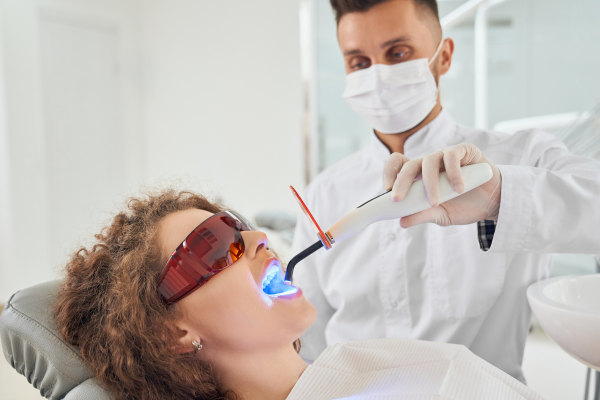
The system used here is SmartBleach with KTP laser activation. A pH-balanced, peroxide-based gel is applied to the teeth, then activated by a KTP laser at a specific wavelength, driving deeper and more uniform stain removal than the gel could manage alone.
The KTP approach is designed to be selective and gentle on soft tissues compared with the UV and LED lights used in many systems, and the treatment is built to minimise the sensitivity associated with some traditional whitening methods.
The appointment itself is straightforward from the patient side: the gums are protected, the gel is applied and activated in controlled cycles, and you simply lie back between stages. There are no needles involved, and most people head straight back to their day afterwards.
The headline practicality: noticeably whiter teeth from a single appointment of around 90 minutes, which is what makes it viable for people whose calendars do not accommodate multi-week whitening programs.
Realistic Expectations: The Part the Ads Skip
Results genuinely vary from person to person, and an honest practice says so. Surface stains from coffee and wine respond best; discolouration that comes from inside the tooth, from certain medications or old injuries, responds less predictably and sometimes calls for a different treatment entirely.
Existing dental work does not whiten. Crowns, veneers and fillings keep their colour, so if you have visible restorations, the whitening plan needs to account for them, another reason assessment comes before enthusiasm.
Aftercare decides longevity. The same coffee habit that created the stains will eventually start rebuilding them, so results last longest with sensible habits, good daily care and regular professional cleaning. A checkup and clean beforehand also gives whitening its best canvas, since gel works on enamel, not on plaque.
A Smile Upgrade That Fits a Macquarie Street Lunch Break
Convenience is the quiet selling point for city workers. The clinic sits in Park House at Level 14, 187 to 191 Macquarie Street, in the heart of the Sydney CBD, and a single 90-minute appointment is the kind of thing a workday can actually absorb.
The experienced team runs whitening consultations to assess suitability first, so you know before committing whether your particular staining is the kind laser whitening rewards.
There is also a seasonal logic to booking now. Treating winter’s accumulated staining in June or July means the result is established well before spring’s run of weddings, races and end-of-year photographs, rather than scrambling for an appointment the week before an event.
Booking a whitening consultation is the practical first move, with appointments arranged online or through the practice’s contact page.
The Takeaway
For coffee-stained teeth, laser whitening is worth considering precisely because it solves the two problems home kits cannot: strength and supervision. A KTP laser system delivers professional-grade whitening in a single 90-minute visit, with a dentist first confirming your discolouration is the kind that will respond, and your teeth healthy enough to treat. Horizon Dental offers SmartBleach KTP laser whitening from its Macquarie Street dental clinic in the Sydney CBD, and a whitening consultation is the honest way to find out what your smile can realistically gain before spring.
Frequently Asked Questions
How long does laser teeth whitening take?
With the SmartBleach KTP system, treatment is completed in a single appointment of around 90 minutes. The gel is applied, activated by the laser in controlled stages, and you leave the same visit with noticeably whiter teeth, which is the main practical advantage over multi-week home programs.
Does laser whitening damage enamel or cause sensitivity?
The KTP laser approach uses a pH-balanced gel and is designed to be gentle on teeth and soft tissues, minimising the sensitivity associated with some traditional systems. Individual responses vary, which is why a dentist assesses your teeth and gums before treatment and manages the process throughout.
How long do whitening results last?
It depends largely on habits. Coffee, tea, red wine and smoking gradually rebuild staining, while good daily care and regular professional cleaning extend results. Many people maintain their improvement for a long time with sensible habits, though no whitening treatment is permanent.
Will whitening work on crowns, veneers or fillings?
No. Whitening changes the colour of natural enamel only, so existing restorations keep their original shade. If you have visible dental work, the dentist plans around it, sometimes whitening first and then matching or updating restorations so the overall result looks uniform.
Is professional whitening better than supermarket kits?
They are different tools. Home kits use lower concentrations and deliver slower, more modest change, while in-chair whitening applies professional-strength gel under clinical supervision with your suitability assessed first. For meaningful change on stubborn staining, the professional route is generally the more predictable one.
This blog is intended for general informational purposes only and does not constitute medical or dental advice. Every patient’s oral health needs are unique. Please consult a qualified dental practitioner for advice specific to your situation. Horizon Dental encourages all patients to seek a professional assessment before commencing any dental treatment.